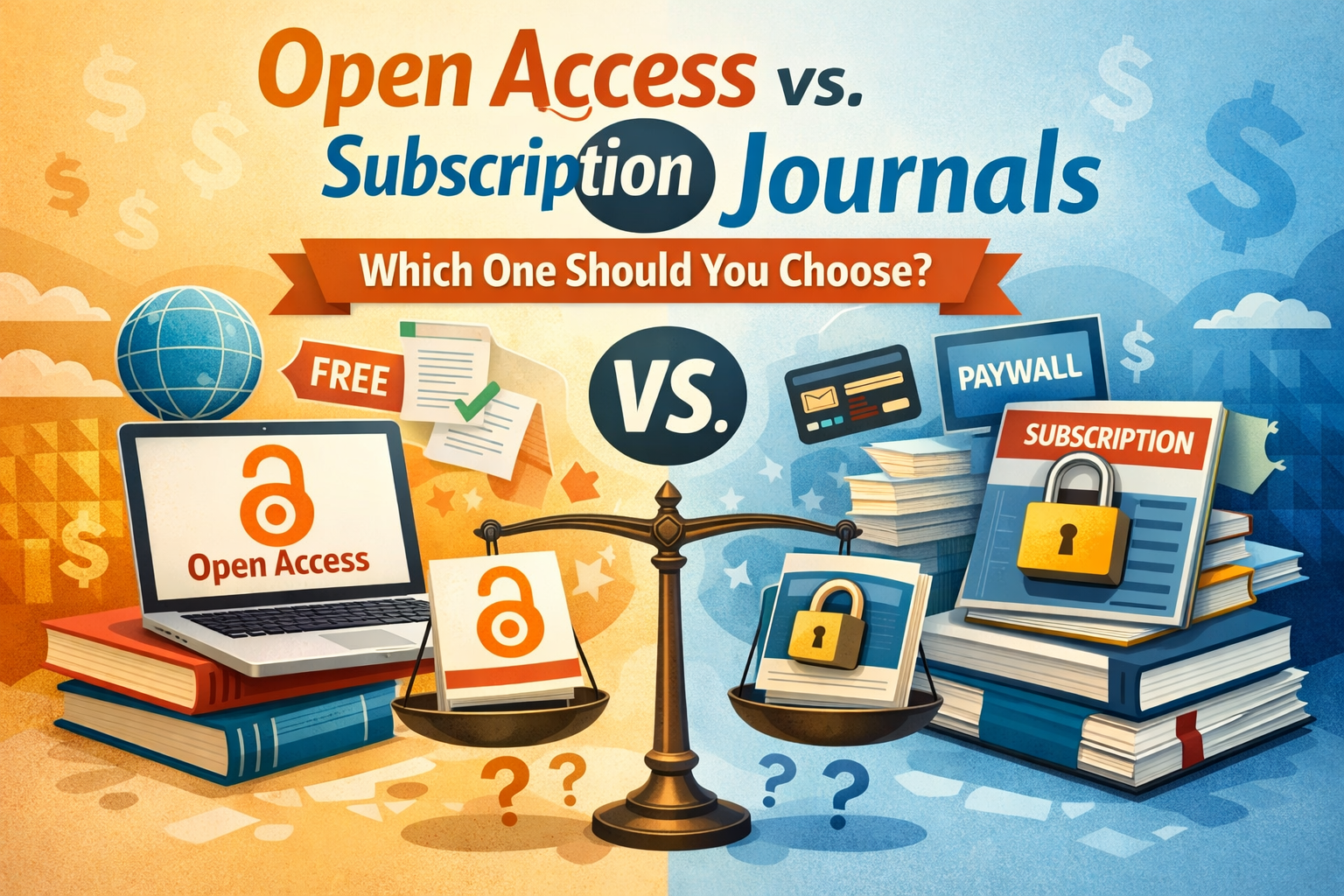
Open Access vs. Subscription Journals: Which One Should You Choose?
Introduction
The world of academic publishing
has transformed dramatically over the past two decades. With the rise of
digital libraries, online repositories, and global knowledge-sharing
initiatives, researchers today must navigate different publishing models—especially
when deciding between Open Access (OA) and Subscription-Based (Closed Access)
journals. This decision plays a crucial role in determining the visibility,
impact, and long-term reach of your research. Yet, many first-time researchers
are unsure which model best suits their needs, goals, and financial realities.
This comprehensive blog explores both publishing models in detail, discussing
their advantages, disadvantages, ethical concerns, cost implications,
reputation factors, and long-term academic impact. By the end, you’ll have a
clear understanding of how to choose the best option for your research journey.
1. Understanding the Two Publishing Models
Academic journals traditionally
followed a subscription model, where readers or institutions paid to access
articles. Over time, however, scholars argued that publicly funded research
should be freely accessible to the world. This led to the rise of Open Access
publishing, which has grown exponentially in recent years.
Before diving into comparisons,
it’s essential to understand how each model works.
1.1 What Are Open Access
Journals?
Open Access (OA) journals make
research articles freely available to everyone. Anyone with an internet
connection can read, download, share, or cite the article without paying fees.
OA journals operate on the principle that scientific knowledge should not be
restricted behind paywalls, especially when much of the research is supported
by public funds or international grants.
There are several types of Open
Access models:
- Gold Open Access: The final published article
is freely available immediately upon publication. Authors often pay an
Article Processing Charge (APC).
- Green Open Access: Authors publish in a
subscription journal but are allowed to deposit a free version (preprint
or postprint) in an institutional repository.
- Diamond/Platinum Open Access: Articles are
free for both authors and readers, funded by institutions, societies, or
government grants.
- Hybrid Journals: Subscription journals that
offer authors the option to make individual articles open access for an
APC.
The rapid expansion of OA has
been driven by universities, libraries, funding agencies, and global bodies
demanding broader access to knowledge.
1.2 What Are Subscription
Journals?
Subscription journals require
readers, universities, or libraries to pay for access. This traditional model
dominated academic publishing for decades. In a subscription system:
- Authors usually do not pay publishing fees.
- Publishers generate revenue from institutional
subscriptions.
- Articles are accessible only to those who have
paid.
Subscription journals remain
highly respected, especially in established disciplines such as mathematics,
engineering, physics, classical humanities, and certain branches of medicine.
Many of the world’s top-ranking journals still use subscription-based or hybrid
models.
2. Advantages of Open Access Journals
Open Access journals offer
numerous benefits that have influenced the global shift toward open science.
Here are the major reasons researchers choose OA publishing.
2.1 Wider Reach and Global
Visibility
The most significant advantage of
OA is the unrestricted global access. Researchers from low-income countries,
independent scholars, professionals outside academia, and students without
institutional subscriptions can access your work freely.
This wide availability leads to:
- Broader readership
- Greater knowledge dissemination
- Increased academic influence
An article hidden behind a
paywall might only reach a limited audience, while Open Access ensures your
work can inform and inspire anyone.
2.2 Higher Citation Potential
Studies consistently show that
Open Access articles tend to receive more citations. Because more readers can
access the full text, your work is more likely to be referenced in theses,
dissertations, journal articles, conference papers, and policy documents.
For early-career researchers,
citation counts are crucial for:
- PhD admissions
- Scholarship applications
- Academic promotions
- Research funding
- Building a strong academic portfolio
Thus, the OA model directly
supports long-term scholarly visibility.
2.3 Compliance With Funding
Agency Requirements
Many national and international
funding agencies have adopted Open Access mandates. Organizations such as:
- The European Commission (Horizon programs)
- NIH (National Institutes of Health)
- UK Research and Innovation
- India’s DBT, DST, and CSIR
- Wellcome Trust
- Bill and Melinda Gates Foundation
require or strongly encourage
researchers to publish in Open Access journals or deposit their work in
institutional repositories.
Publishing OA ensures compliance
and avoids conflicts with grant terms.
2.4 Authors Retain More Control
Over Their Work
OA journals often allow authors
to retain copyright through Creative Commons licenses, such as CC BY, CC BY-NC,
or CC BY-SA. This means:
- You can share your article freely
- You can use it in your teaching materials
- You can upload it to your website or LinkedIn
- Other researchers can reuse your work with
attribution
In contrast, subscription
journals usually require a full copyright transfer, limiting how you can
distribute your own research.
2.5 Accelerated Knowledge Sharing
OA journals generally prioritize
rapid dissemination. Because their financial model depends on publishing rather
than subscription revenue, the editorial process often moves faster. This is
especially beneficial for fast-evolving fields such as:
- Artificial Intelligence
- Machine Learning
- Biomedicine
- Renewable Energy
- Climate Science
- Nanotechnology
Faster publication means your
research contributes to timely scientific progress.
3. Disadvantages of Open Access Journals
While Open Access offers numerous
benefits, it also carries certain drawbacks researchers must be aware of.
3.1 High Article Processing
Charges (APCs)
The biggest challenge with OA
journals is the cost. Article Processing Charges can range from:
- $300 to $800 for regional or small OA journals
- $1500 to $3500 for mid-tier OA publishers
- $4000 to $10,000 for top-tier OA publishers
(e.g., Nature OA)
For students, early researchers,
or those without funding support, such fees can be a major barrier.
3.2 Increased Risk of Predatory
Journls
The OA model has unintentionally
encouraged the rise of predatory publishers journals that charge fees but skip
peer review, accept low-quality papers, and provide no real editorial
oversight.
These journals:
- Publish almost anything for money
- Have fake editorial boards
- Are not indexed in Scopus or Web of Science
- Damage an author’s academic credibility
Distinguishing between legitimate
OA journals and predatory ones is crucial.
3.3 Perception of Lower Prestige
in Some Fields
Although many OA journals are
excellent, certain academic communities still favor traditional subscription
outlets. In disciplines such as philosophy, core theoretical physics, or
classical studies, subscription journals have long-standing prestige and historical
influence.
In such fields, OA may be viewed
as less prestigious even when the journal is reputable.
4. Advantages of Subscription Journals
Subscription-based journals
remain the foundation of academic publishing, especially in older, more
established disciplines. Their advantages include reputation, rigorous peer
review, and long-standing credibility.
4.1 Strong Academic Prestige
Many top-tier journals in
science, engineering, social sciences, and humanities still operate under
subscription models. These journals often have:
- Decades or even centuries of publication
history
- Highly respected editorial teams
- Strong peer-review standards
- High impact factors
Publishing in such journals adds
weight to a researcher’s academic profile and is often considered a mark of
excellence.
4.2 No Publication Fees
In most subscription journals,
authors do not pay APCs. This makes them ideal for:
- Students
- Early researchers
- Scholars without funding
- Researchers from developing countries
While some subscription journals
have page or color charges, these are typically much lower than OA fees.
4.3 Rigorous Peer Review
Because subscription publishers rely on reputation
to maintain subscriptions, they cannot afford low editorial standards. Most
subscription journals follow:
- Double-blind
peer review
- Multiple
reviewers per paper
- Thorough
revision cycles
- Strict
acceptance criteria
The result is a higher level of scholarly
reliability.
4.4 Established Impact and
Influence
Subscription journals have
historically dominated academic impact rankings. Their influence is recognized
by:
- Universities
- Funding agencies
- Accreditation bodies
- Hiring committees
For career advancement,
especially in traditional academic systems, subscription journals often carry
significant weight.
5. Disadvantages of Subscription Journals
While subscription journals offer
prestige and quality, they also have limitations.
5.1 Restricted Access
Access is limited only to those
who pay subscription fees. This restricts readership drastically, especially
for:
- Developing countries
- Independent scholars
- Small institutions
- Non-academic professionals
Limited access reduces visibility,
citations, and real-world impact.
5.2 Slower Publication Cycles
Subscription journals often have
lengthy review processes. High submission volumes, strict standards, and
traditional workflows can lead to:
- Long waiting times
- Multiple revision rounds
- Delays in publication
In some journals, the review
process can take 12–24 months.
5.3 Authors Lose Copyright
Most subscription journals
require authors to transfer copyright to the publisher. Once transferred:
- Authors cannot freely share their work
- Uploading full-text versions is often
restricted
- Readers cannot reuse or distribute the content
This limits academic freedom and
global reach.
6. Hybrid Journals: A Combination of Both Models
Hybrid journals offer a
compromise. They operate as subscription journals but allow authors to make
their individual articles Open Access by paying an APC.
Benefits:
- You publish in a prestigious subscription
journal.
- Your article becomes instantly open to all
readers.
- You retain some copyright privileges.
Limitations:
- APCs in hybrid journals are often the highest
in the industry.
- Some argue that hybrid publishing leads to
“double dipping”—publishers earn both APCs and subscription fees.
Hybrid models are widely used in
fields where traditional journals dominate but OA demand is growing.
7. How to Choose Between Open Access and Subscription Journals
Selecting the right publishing
model depends on your goals, financial situation, research field, and
visibility expectations. Below are key factors to guide your choice.
7.1 Choose Open Access If You
Want Maximum Visibility
If your priority is:
- High readership
- Wider dissemination
- Global accessibility
- High citation potential
then Open Access is the ideal
choice.
This is particularly beneficial
for early-career researchers trying to build a strong citation profile.
7.2 Choose Subscription Journals
for Academic Prestige
If your goal is:
- Academic promotions
- Tenure track positions
- Highly competitive programs
- Publishing in historic high-impact journals
then subscription journals may
better align with your needs.
7.3 Choose Open Access If Your
Research Is Funded
If your project has grant funding
from agencies that require or encourage open dissemination, choose OA. Many
grants explicitly mandate that research findings must be publicly accessible.
7.4 Choose Subscription Journals
If You Cannot Afford APCs
If you do not have institutional
support or personal funds to pay high APCs, then subscription journals are more
affordable.
You may also explore:
- Diamond OA journals (no APC)
- Society-based journals
- University-published OA journals
- Repositories for Green OA
7.5 Choose Open Access for Fast
Publication
If your field moves quickly, or
if timely publication is important to you (for career deadlines), OA journals
are typically faster.
7.6 Choose Subscription Journals
If Your Discipline Prefers Tradition
Certain disciplines continue to
value subscription models due to their long-standing influence. If you are in
such a field, evaluate the expectations of your academic community.
8. Checking Journal Quality and Avoiding Predatory Publishers
Regardless of whether you choose
Open Access or Subscription, always check for:
- Scopus indexation
- Web of Science indexing
- DOAJ listing (for Open Access)
- Journal Impact Factor
- Citation Score
- Editorial board authenticity
- Peer review policies
- Publisher reputation
- Review duration
- History and frequency of issues
Poor-quality or predatory
journals can harm your academic credibility.
Conclusion
Choosing between Open Access and
Subscription journals is not a one-size-fits-all decision. Both models offer
unique advantages and limitations, and your choice depends on factors such as
visibility goals, funding availability, disciplinary expectations, and career
aspirations.
Open Access journals provide
unparalleled visibility, broader readership, and higher citation potential,
making them ideal for early-career researchers or those seeking global
outreach. However, the high APCs and presence of predatory publishers can be significant
barriers.
On the other hand, Subscription
journals offer strong prestige, rigorous peer review, and affordability for
authors. They remain the preferred choice in many traditional academic fields,
but limited accessibility may restrict your research’s global impact.
Ultimately, the best approach is
to weigh your goals carefully:
- If you value open knowledge, visibility, and
global impact choose Open Access.
- If you value academic prestige, traditional
recognition, and affordability choose Subscription.
- If you want a mix of both consider Hybrid
journals.
Your research deserves to be
seen, cited, and respected. By making an informed decision, you ensure your
work reaches the right audience and contributes meaningfully to the global
scientific community.