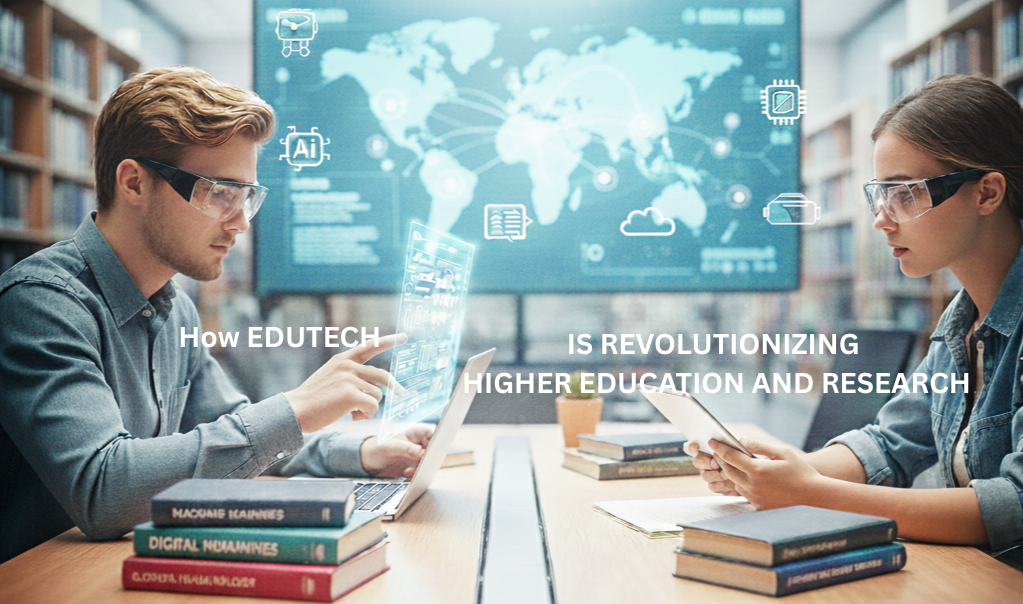
How EduTech is Revolutionizing Higher Education and Research
Introduction
Education is undergoing one of
the most transformative shifts in history, driven by the rapid integration of
technology into classrooms, laboratories, and research environments. What was
once limited to textbooks, lectures, and physical libraries has evolved into a
dynamic digital ecosystem powered by artificial intelligence, cloud computing,
virtual labs, and immersive learning platforms. EduTech—short for educational
technology—is not just enhancing learning; it is redefining how students
acquire knowledge, how instructors teach, and how researchers innovate. This
revolution is creating more accessible, personalized, and research-driven
academic systems across the world.
The impact of EduTech is profound
because it influences every stage of the educational journey, from content
delivery and assessment to collaboration and scholarly discovery. For higher
education institutions, it means embracing new pedagogical models that prepare
students for an increasingly digital workforce. For researchers, it opens
pathways to faster experimentation, richer data, and global collaboration. This
blog explores how EduTech is reshaping higher education and research while
highlighting the key drivers behind this transformation.
1. Personalized and Adaptive Learning Experiences
One of the most significant
breakthroughs in EduTech is the shift toward personalized learning—where
digital tools adapt to the strengths, weaknesses, and pace of each learner.
Unlike traditional classrooms that follow a uniform model, adaptive systems use
algorithms and real-time analytics to tailor content, difficulty levels, and
learning paths.
Why this
matter
Students have diverse learning
styles, backgrounds, and levels of preparedness. EduTech closes the gap by
offering individualized experiences that improve retention, confidence, and
academic outcomes.
How it
transforms higher education
- Learners progress at their own speed rather
than being constrained by fixed schedules.
- AI-driven tutors provide instant doubt
resolution, practice problems, and conceptual explanations.
- Learning dashboards give educators visibility
into students’ performance, allowing timely intervention.
Personalized learning ensures
that education becomes more inclusive, efficient, and engaging—helping every
student succeed on their own terms.
2. Virtual Classrooms and Global Learning Communities
Online platforms have expanded
the boundaries of higher education beyond geographical and institutional
constraints. Virtual classrooms enable students from different parts of the
world to learn together, participate in discussions, and attend live or recorded
lectures.
Why this
matter
Education becomes accessible to a
wider audience, fostering cultural diversity and global exposure.
How it
transforms higher education
- Students can access courses from top
universities without relocating.
- Instructors reach larger audiences and
experiment with new teaching techniques.
- Breakout rooms, polls, chat modules, and
collaboration tools replicate interactive classroom experiences.
Virtual learning has become a
catalyst for building global academic communities where knowledge flows
seamlessly across borders.
3. Digital Libraries, Open Educational Resources, and Instant Information Access
EduTech has transformed how
learners and researchers access knowledge. Digital libraries and open
educational resources have replaced traditional repositories, offering a wealth
of materials at one’s fingertips.
Why this
matter
Research becomes faster, more
efficient, and more democratized.
How it
transforms higher education and research
- Students can access e-books, journals,
simulations, and multimedia content anytime.
- Open resources reduce the cost of education by
making learning materials freely available.
- Researchers benefit from instant access to
past studies, datasets, and citations—accelerating the research process.
This availability of information
empowers learners to explore beyond the curriculum and supports researchers in
building stronger, evidence-based work.
4. AI-Powered Research Tools and Data-Driven Innovation
Artificial intelligence is
playing a crucial role in modern research, automating complex tasks, generating
insights from massive datasets, and supporting interdisciplinary discovery.
Algorithms can analyze patterns, identify correlations, and produce predictions
at speeds far beyond human capability.
Why these
matters
Researchers can focus more on
ideas, experimentation, and problem-solving rather than tedious manual tasks.
How it
transforms research
- AI assists in literature reviews, data
cleaning, statistical modelling, and visualization.
- Machine learning algorithms enable predictive
modeling in fields such as healthcare, materials science, and
environmental studies.
- Natural language processing helps generate
summaries, detect inconsistencies, and refine technical writing.
AI-driven research workflows
accelerate the publication cycle and raise the accuracy, reproducibility, and
sophistication of academic work.
5. Virtual and Remote Laboratories for Hands-On Learning
Many institutions now offer
virtual labs where students can perform experiments digitally using simulation
platforms. These tools replicate real-world environments, allowing learners to
test theories, manipulate variables, and observe outcomes safely and
conveniently.
Why this
matter
Practical learning becomes
accessible even when physical resources are limited.
How it
transforms higher education
- Students conduct experiments remotely,
overcoming barriers such as equipment scarcity or geographical distance.
- Virtual labs ensure repeated practice without
additional cost or risk.
- Educators can track student interactions and
provide targeted feedback.
For research, remote labs enable
collaboration among institutions and allow experimentation to continue even
during constraints such as travel limitations.
6. Cloud Collaboration and Real-Time Academic Networking
EduTech has made collaboration
seamless. Cloud-based platforms support file sharing, co-authoring, data
storage, and real-time communication among students and researchers.
Why these
matters
Research and learning are
becoming increasingly collaborative, interdisciplinary, and global.
How it
transforms education and research
- Students work on group assignments through
shared workspaces that update instantly.
- Research teams collaborate from different
countries, contributing to manuscripts, datasets, and presentations
simultaneously.
- Cloud storage ensures that work is accessible
from anywhere and securely backed up.
This shift enhances productivity,
reduces communication barriers, and supports a more connected academic
ecosystem.
7. Gamification and Immersive Learning for Higher Engagement
Gamification techniques such as
badges, progress bars, challenges, and interactive modules have reshaped the
way students engage with complex subjects. Meanwhile, immersive technologies
like augmented and virtual reality offer hands-on, experiential learning that
enhances memory and understanding.
Why this
matter
Engagement is directly linked to
learning outcomes, especially in higher education where concepts can be
abstract or technical.
How it
transforms higher education
- Complex theories become interactive and easier
to understand.
- Simulated environments provide real-world
training in fields like medicine, engineering, and architecture.
- Students remain motivated through goal-based
learning structures.
Immersive EduTech experiences
help bridge the gap between theoretical knowledge and practical application.
8. Automated Assessments and Continuous Feedback Systems
EduTech is revolutionizing how
assessments are conducted. Automated grading, adaptive tests, and real-time
feedback systems make evaluation faster, fairer, and more analytical.
Why this
matter
Continuous feedback supports
deeper learning and helps students monitor their progress effectively.
How it
transforms higher education
- Instructors save time through automated
evaluations.
- Students receive instant insights into their
performance.
- Analytics identify the areas where learners
struggle, guiding targeted remediation.
Fair, transparent, and
data-driven assessment systems enhance academic integrity and support
personalized improvement.
9. Enhancing Research Visibility Through Digital Platforms
Digital repositories, academic
social networks, and online publishing tools have made it easier for
researchers to showcase their work to global audiences.
Why these
matters
Visibility increases citations,
collaborations, and academic credibility.
How it
transforms research
- Researchers share preprints, datasets, and
methodologies openly.
- Networking platforms help build scholarly
communities and foster dialogue across disciplines.
- Institutions track research output more
efficiently through digital records and metrics.
The digital shift ensures that
valuable research reaches wider audiences and contributes meaningfully to
global scholarship.
10. Bridging Skill Gaps and Preparing Learners for the Future Workforce
Higher education must equip
students not just with theoretical knowledge but also with practical,
industry-ready skills. EduTech plays a crucial role in bridging this gap.
Why this
matter
Employers increasingly prioritize
digital literacy, critical thinking, and technological proficiency.
How it
transforms higher education
- Online certifications help students upgrade
skills in emerging technologies.
- Virtual internship programs provide industry
exposure.
- Project-based and experiential learning
enhanced by EduTech prepares students for real-world challenges.
EduTech ensures that graduates
are prepared for a rapidly evolving job market, making education more aligned
with global industry needs.
Conclusion
EduTech is not merely supporting
higher education and research it is transforming them. By making learning more
personalized, accessible, engaging, and data-driven, EduTech bridges the gap
between traditional pedagogy and the demands of the future. For researchers, it
unlocks unprecedented opportunities for collaboration, experimentation, and
innovation. As institutions continue to embrace digital transformation, the
future of education promises to be more inclusive, intelligent, and
interconnected.
The revolution is already
underway. Those who adapt to EduTech learners, educators, and researchers
alike—will not only enhance their academic journeys but also contribute to
shaping a more advanced and knowledge-driven society.