The Invisible Hand Shaping Today’s Books
Introduction
In an era defined by unprecedented access to information and creative tools, literature might appear freer than ever. Anyone can write, publish, and distribute a book with minimal barriers. Yet paradoxically, contemporary books display striking similarities in structure, theme, pacing, and even emotional cadence. This uniformity raises a critical question: who—or what—is shaping today’s books?
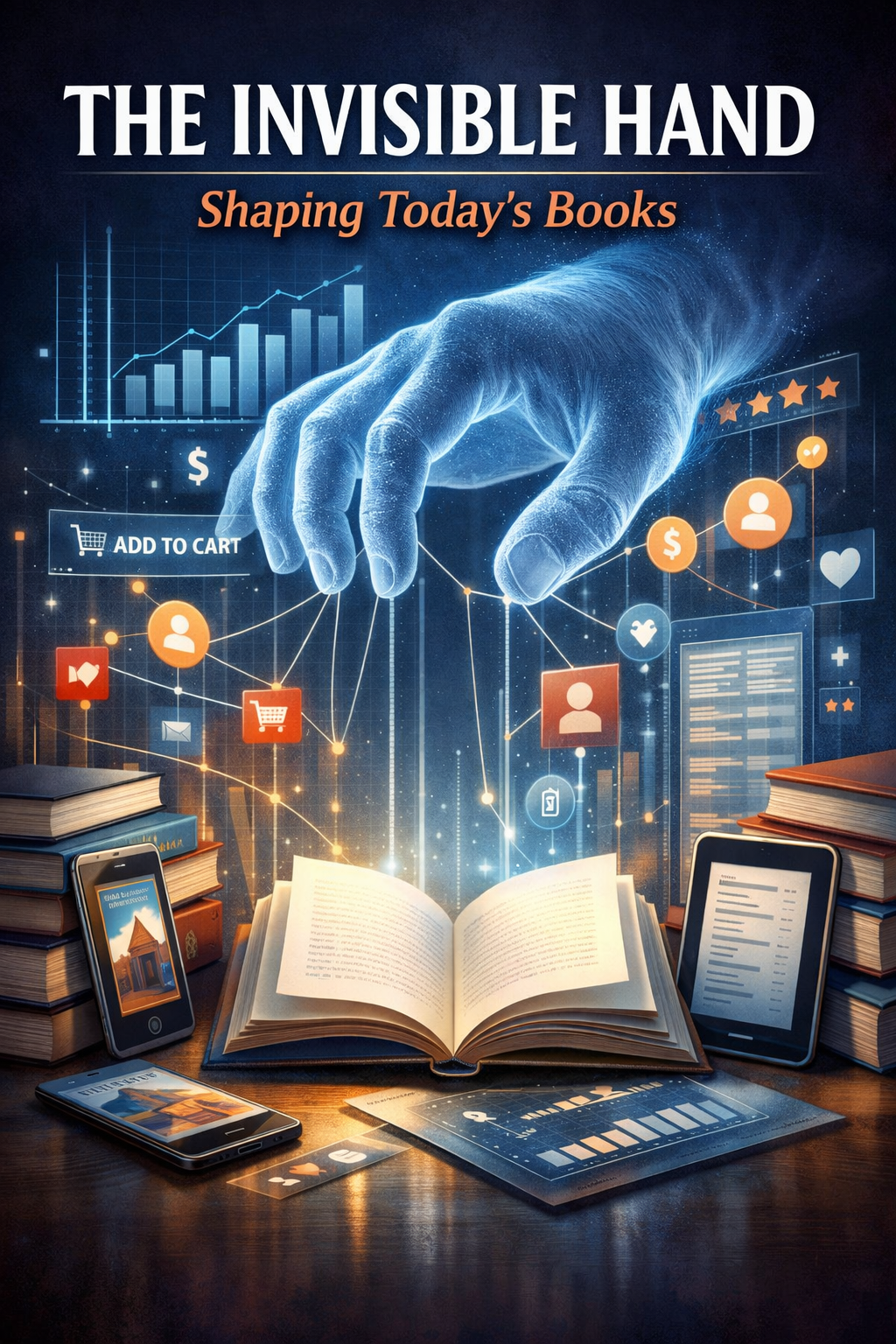
The answer lies not in a single authority but in a diffuse, largely unseen force: an “invisible hand” composed of algorithms, market economics, platform incentives, cultural trends, and collective reader behavior. This force operates quietly yet decisively, influencing what stories are told, how they are written, and which voices ultimately reach readers.
Understanding this invisible hand is essential—not only for writers and publishers, but for readers who wish to engage with literature consciously rather than passively.
1.The Evolution of Literary Influence
Historically, literature has always been shaped by power structures. In earlier centuries, patronage systems, religious institutions, and monarchies determined which works survived. The twentieth century replaced these with publishing houses, editors, critics, and literary awards as primary gatekeepers.
The digital age, however, has fundamentally altered this structure. Authority has not disappeared; it has decentralized and automated. Today, influence is exerted less through human judgment and more through data-driven systems that prioritize engagement, scalability, and profitability.
The result is a shift from editorial curation to algorithmic mediation.
2. Algorithms as Contemporary Gatekeepers
Modern reading platforms do not evaluate books for artistic depth or intellectual contribution. Instead, they measure behavior: how quickly readers engage, how long they remain, and whether they continue to the next page or purchase similar content.
Key metrics include:
- Click-through rates
- Reading completion percentages
- User highlights and annotations
- Reviews and star ratings
- Purchase and recommendation loops
These metrics shape recommendation systems, which in turn determine visibility. Books that align with algorithmic preferences are promoted; those that do not are effectively marginalized.
- Consequently, many contemporary books are engineered to:
- Begin with immediate narrative tension
- Minimize slow or reflective openings
- Maintain consistent emotional stimulation
- Adhere to familiar narrative frameworks
This does not necessarily diminish quality, but it redefines success. Literary value becomes secondary to reader retention.
3. The Standardization of Narrative Forms
One of the most visible outcomes of algorithmic influence is the dominance of narrative tropes. While tropes have long existed as storytelling tools, they are now explicitly marketed as product features.
Books are frequently described using standardized labels such as:
- “Enemies to Lovers”
- “Found Family”
- “Dark Academia”
- “Trauma-to-Healing Arc”
- “Redemption Narrative”
These descriptors function similarly to search engine keywords, optimizing discoverability rather than interpretive richness. For authors—particularly debut writers—adhering to recognizable tropes reduces market risk and increases the likelihood of publication or visibility.
However, this emphasis on classification encourages predictability over innovation. Stories that resist categorization or challenge narrative norms face structural disadvantages in the current ecosystem.
4. Social Media and the Economy of Visibility
Social media platforms have become among the most influential forces in contemporary publishing. Viral book recommendations—particularly through platforms such as TikTok, Instagram, and YouTube—can transform obscure titles into global bestsellers within days.
Yet virality operates according to its own logic. Content that performs well online often emphasizes:
- Immediate emotional impact
- Relatable or confessional themes
- Quotable, isolated lines
- Visually or aesthetically appealing packaging
Subtle, ambiguous, or slow-burning narratives struggle to compete in an environment optimized for rapid consumption and emotional immediacy.
As a result, some authors increasingly write with platform performance in mind, consciously shaping scenes or dialogue for excerptability rather than narrative necessity.
5. Economic Constraints and Risk Aversion
Publishing remains a financially precarious industry. Rising production costs, shrinking attention spans, and intense competition have led publishers to prioritize projects perceived as “safe.”
Manuscripts are often evaluated through questions such as:
- Can this be summarized in a single sentence?
- Does it resemble a recent commercial success?
- Is it aligned with current market trends?
While understandable from a business perspective, this approach reinforces homogeneity. Experimental, unconventional, or difficult works face greater barriers to entry—not because they lack merit, but because they lack predictability.
Thus, the invisible hand of economics subtly narrows the range of stories that reach mainstream audiences.
6. The Reader as a Participatory Agent
Readers are not passive victims of this system. Collectively, reader behavior trains algorithms and reinforces market incentives.
- Patterns such as:
- Abandoning slower texts
- Favoring comfort reads
- Engaging more frequently with trending titles
- Offering limited feedback on challenging works
All contribute to shaping the literary landscape.
In an environment saturated with options, readers understandably gravitate toward socially validated choices.However, this reliance on consensus further amplifies dominant narratives and marginalizes unconventional voices.
The invisible hand, therefore, is not imposed solely from above—it is co-created through cumulative individual actions.
7. Artificial Intelligence and Predictive Publishing
Artificial intelligence introduces a new layer of influence. Increasingly, AI tools are used to:
- Analyze market trends
- Predict reader preferences
- Optimize plot structures
- Assist with language refinement
While these tools enhance efficiency, they also risk reinforcing existing norms. AI systems learn from historical data; if past success is narrow, future recommendations will be narrower still.
The primary concern is not automation, but creative convergence—a gradual erosion of diversity as systems optimize for what has already proven profitable.
8. Advantages of the Contemporary System
Despite its limitations, the modern publishing ecosystem offers significant benefits:
- Reduced barriers for marginalized voices
- Global reach for niche literature
- Greater autonomy through self-publishing
- Community-driven discovery mechanisms
Stories once excluded from traditional publishing now find audiences directly. This democratization should not be underestimated.
However, access alone does not guarantee longevity or cultural impact.
9. What Is at Risk
The greatest loss posed by the invisible hand is not literary quality, but literary breadth.
Works that demand patience, ambiguity, or intellectual effort are increasingly rare in mainstream visibility. Many historically significant texts—slow, difficult, resistant to categorization—would likely fail today’s engagement metrics.
The invisible hand does not censor literature.It simply prioritizes efficiency over endurance.
10. Toward Conscious Engagement
Resistance need not be radical. It can be deliberate.
- Readers can seek books beyond trending lists
- Writers can preserve creative integrity despite pressure
- Publishers can balance commercial success with cultural responsibility
- Critics and educators can amplify overlooked voices
Small, intentional acts—finishing challenging books, writing thoughtful reviews, recommending non-viral works—can meaningfully disrupt algorithmic momentum.
Conclusion: Awareness as Agency
The invisible hand shaping today’s books is neither malicious nor accidental. It is the product of interconnected systems responding to technological, economic, and cultural realities.
Recognizing its influence does not diminish literature’s value—it restores agency to those who create and consume it.
Books remain among humanity’s most powerful tools for reflection, dissent, and imagination. But in a world where visibility is engineered, conscious choice becomes an act of preservation.
The future of literature will not be determined solely by algorithms or markets, but by readers and writers willing to look beyond what is effortlessly offered—and turn pages with intention.