How Data Has to Be Analysed: From Raw Numbers to Real Insights
Introduction
In
today’s digital world, data is everywhere. Every click, transaction, sensor
reading, social media post, and customer interaction generates information.
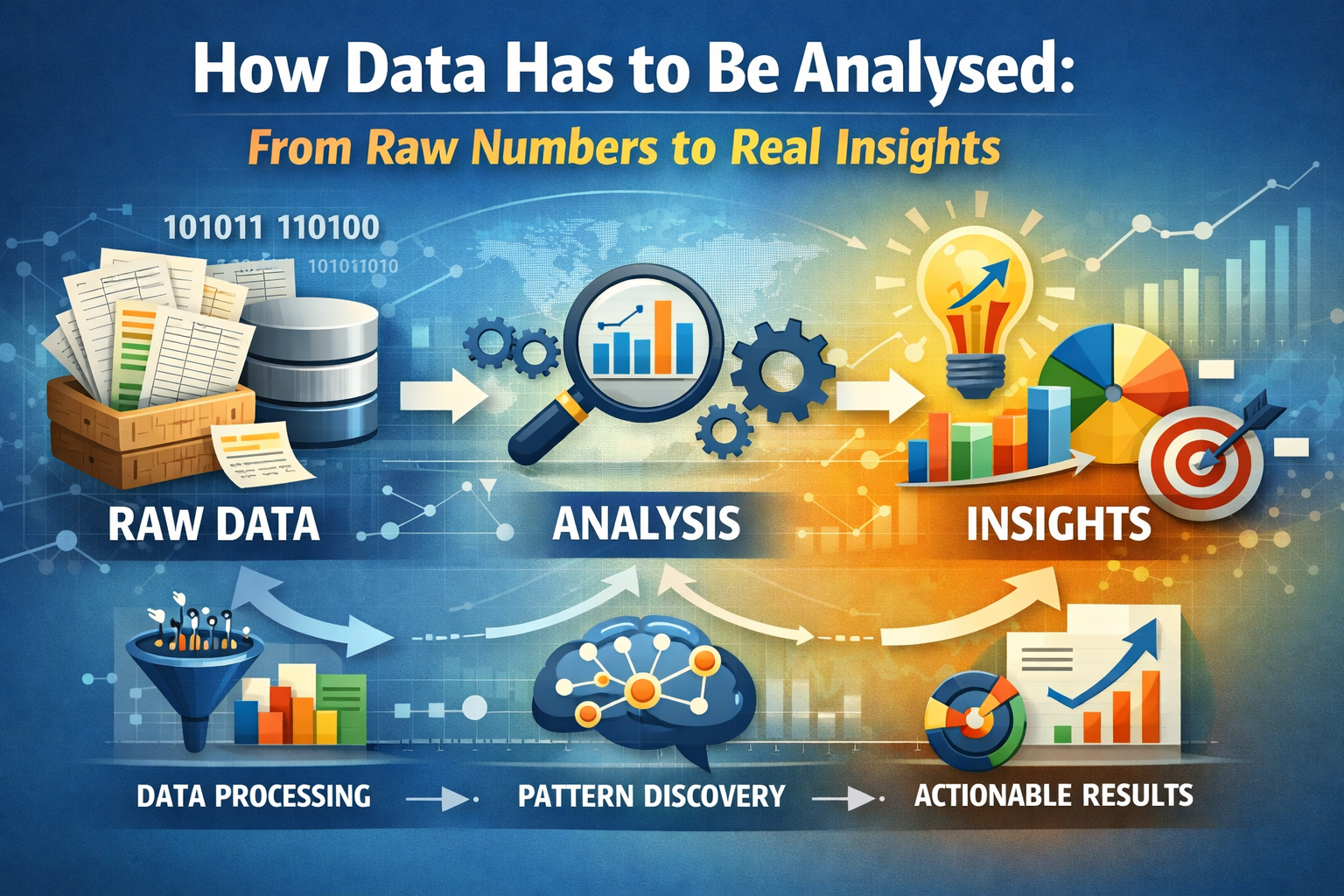
However, raw data by itself has little value. Its true power lies in how it is
analysed. Data analysis is the process that transforms unstructured facts and
figures into meaningful insights that drive decision-making, innovation, and
strategic growth. Understanding how data has to be analysed is therefore
essential for organizations, researchers, and individuals alike.
Understanding the Purpose of Data Analysis
Before
any analysis begins, it is crucial to define the purpose. Data analysis is not
about exploring numbers randomly; it is about answering specific questions or
solving particular problems. Whether the goal is to improve customer
satisfaction, predict future trends, reduce operational costs, or test a
hypothesis, clarity of purpose shapes the entire analytical process.
A
well-defined objective helps determine what data is relevant, which analytical
methods should be used, and how results should be interpreted. Without a clear
purpose, analysis risks becoming unfocused, leading to misleading conclusions
or wasted effort.
Data Collection: The Foundation of Analysis
The
quality of analysis depends heavily on the quality of data collected. Data must
be accurate, relevant, complete, and timely. Poor-quality data leads to poor
insights, regardless of how sophisticated the analytical techniques may be.
Data
can be collected from multiple sources such as databases, surveys, sensors, web
analytics tools, and third-party platforms. During this stage, analysts must
ensure consistency in data formats, definitions, and measurement units. Ethical
considerations, such as data privacy and consent, must also be addressed to
maintain trust and compliance with regulations.
Data Cleaning and Preparation
Raw
data is rarely ready for immediate analysis. It often contains missing values,
duplicates, errors, or inconsistencies. Data cleaning is therefore one of the
most critical and time-consuming steps in the analysis process.
This
stage involves removing irrelevant data, correcting inaccuracies, handling
missing values, and standardizing formats. Data preparation may also include
transforming variables, creating new features, or aggregating data to the
required level of detail. Though this step may seem tedious, it ensures that
the analysis is based on reliable and structured information.
Choosing the Right Analytical Approach
How
data has to be analysed largely depends on the type of data and the question
being asked. Analytical approaches generally fall into several categories:
- Descriptive
analysis focuses on summarizing past data to understand what has happened.
This includes measures such as averages, percentages, and frequency
distributions.
- Diagnostic
analysis aims to explain why something happened by identifying patterns
and relationships within the data.
- Predictive
analysis uses historical data and statistical models to forecast future
outcomes.
- Prescriptive
analysis goes a step further by recommending actions based on predicted
results.
Selecting
the appropriate approach ensures that the analysis aligns with the intended
objective and delivers actionable insights.
Applying Statistical and Analytical Techniques
Once
the approach is chosen, appropriate techniques must be applied. These may range
from basic statistical methods such as correlation and regression to advanced
techniques like machine learning and data mining.
Statistical
analysis helps identify trends, relationships, and anomalies within data.
Visualization tools such as charts, graphs, and dashboards are also essential,
as they make complex data easier to understand and communicate. Effective
visualization highlights key findings and allows stakeholders to grasp insights
quickly without needing deep technical expertise.
Interpreting Results Thoughtfully
Analysis
does not end with calculations or models. Interpretation is where data becomes
knowledge. Analysts must carefully examine results in the context of the
original objective and real-world conditions.
It
is important to avoid overgeneralization or assuming causation where only
correlation exists. External factors, biases, and limitations of the data
should be acknowledged. Thoughtful interpretation ensures that conclusions are
realistic, balanced, and aligned with practical realities.
Communicating Insights Clearly
Even
the most accurate analysis has little value if its findings are not
communicated effectively. Results must be presented in a clear, concise, and
audience-appropriate manner. Technical details may be suitable for data
scientists, while decision-makers often prefer high-level summaries supported
by visual evidence.
Storytelling
plays a key role in data communication. By framing insights within a
narrative—highlighting the problem, the analysis, and the outcome—analysts can
make data more engaging and impactful. Clear communication enables informed
decision-making and fosters trust in the analysis.
Continuous Evaluation and Improvement
Data
analysis is not a one-time activity. As new data becomes available and
conditions change, analyses must be revisited and refined. Continuous
evaluation helps identify errors, improve models, and adapt insights to
evolving circumstances.
Feedback
from stakeholders also plays an important role. Understanding how insights are
used in practice can guide improvements in data collection, analysis methods,
and reporting styles. This iterative process ensures that data analysis remains
relevant and valuable over time.
Ethical and Responsible Data Analysis
An
often-overlooked aspect of data analysis is ethics. Analysts must ensure
fairness, transparency, and accountability in how data is used. This includes
avoiding biased data sets, protecting sensitive information, and being honest
about uncertainties and limitations.
Responsible
data analysis builds credibility and ensures that insights benefit society
rather than cause harm. Ethical considerations should be integrated throughout
the analytical process, from data collection to interpretation and
communication.
Conclusion
How
data has to be analysed is not just a technical question but a strategic one.
Effective data analysis requires clear objectives, high-quality data, careful
preparation, appropriate methods, thoughtful interpretation, and clear
communication. When done correctly, data analysis transforms raw information
into powerful insights that guide decisions, drive innovation, and create
value.
In an increasingly data-driven
world, the ability to analyses data effectively is no longer optional—it is
essential. By following a structured and responsible approach, organizations
and individuals can unlock the true potential of data and use it as a reliable foundation for progress.