The Tragedy of Aeroflot Flight 593: When Automation and Human Error Collided
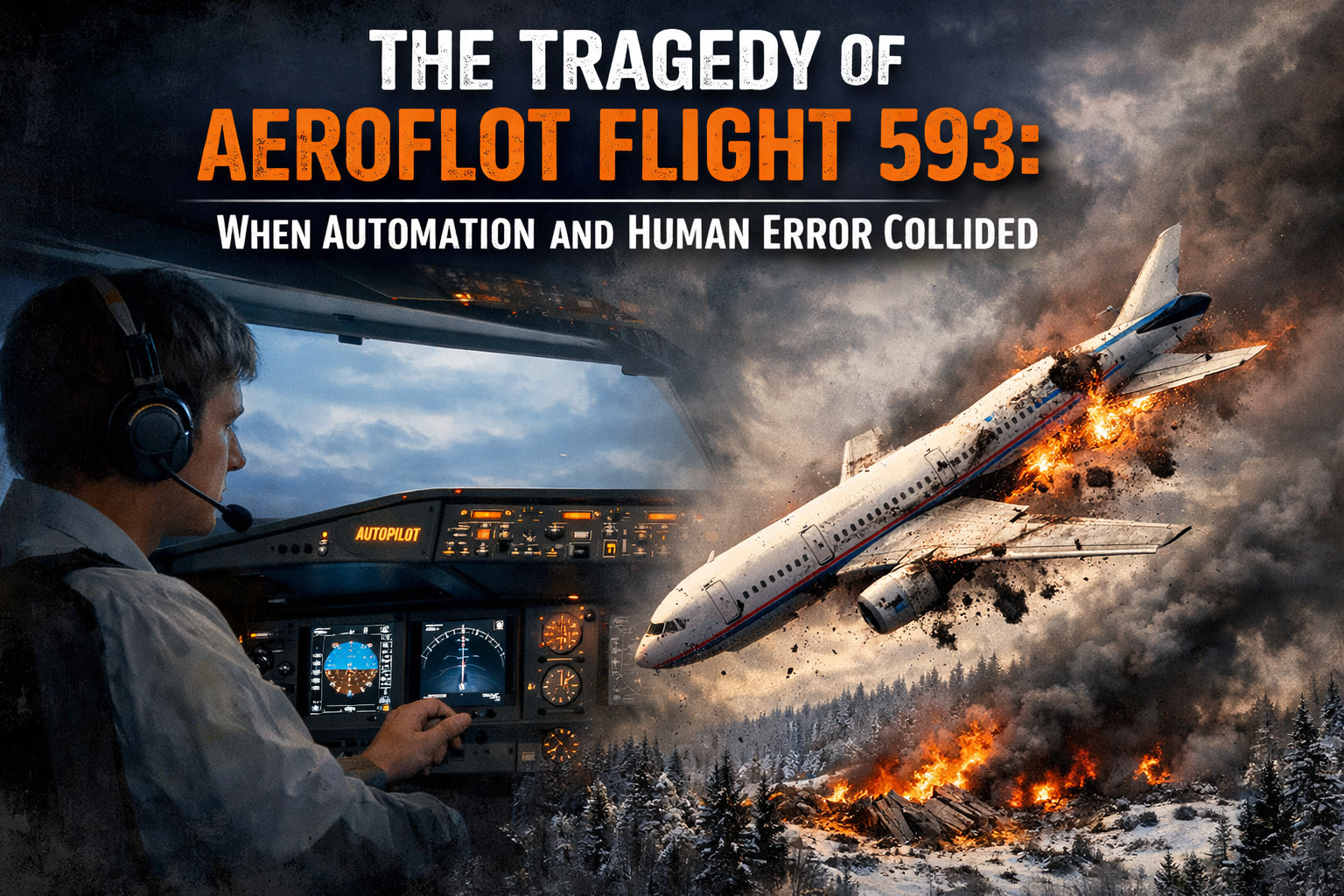
On
March 23, 1994, a routine overnight international flight turned into one of
aviation’s most studied tragedies. Aeroflot Flight 593 was en route from Moscow
to Hong Kong when it crashed into the Kuznetsk Alatau mountains in Siberia. All
75 people on board lost their lives.
What
made this accident especially haunting was not mechanical failure, bad weather,
or terrorism — but a chain of human decisions involving cockpit access,
automation misunderstanding, and split-second overcorrections.
The Aircraft and Crew
The
aircraft was an Airbus A310-304, a modern, Western-built airliner at the time.
It was operated by Aeroflot during a transitional era when Russian crews were
adapting from Soviet-designed aircraft to more automated Western systems.
The
flight deck crew consisted of:
- Captain Andrey Danilov
- First Officer Igor Piskaryov
- Relief Captain Yaroslav
Kudrinsky
The
crew were experienced pilots — but relatively new to the Airbus A310 compared
to aircraft they had previously flown.
A Critical Mistake: Children in the Cockpit
During
cruise flight, the relief captain brought his two teenage children into the
cockpit — a serious violation of aviation safety regulations.
First,
his daughter briefly sat in the pilot’s seat while the autopilot remained
engaged. No issue occurred.
Then
his 15-year-old son took the seat.
What
happened next would change aviation training discussions forever.
The Invisible Autopilot Disengagement
The
Airbus A310’s autopilot system allowed limited manual input without fully
disengaging. When the teenager applied force to the control column for about 30
seconds, it partially disconnected the autopilot’s control of the ailerons
(which control roll).
Here’s
the critical part:
- The autopilot continued
controlling other systems.
- There was no loud warning
alarm.
- Only a small visual indicator
showed the change.
- The pilots did not immediately
notice.
The
aircraft slowly began banking to the right.
At
first, the change was subtle. Then it wasn’t.
From Bank to Near-Vertical Dive
The
aircraft rolled past 45 degrees — then toward 90 degrees.
Because
commercial airliners are not designed to maintain altitude at extreme bank
angles, the A310 began descending rapidly. The autopilot attempted to
compensate by increasing pitch and thrust, but this led to an aerodynamic
stall.
At
that point:
- The autopilot disengaged
completely.
- The aircraft entered a steep
dive.
- G-forces made movement in the
cockpit difficult.
The
crew regained control briefly — but then overcorrected.
The Fatal Overcorrections
The
first officer pulled up aggressively to recover from the dive. The aircraft
pitched into a near-vertical climb. Airspeed dropped rapidly.
Another
stall.
The
aircraft entered a spin.
The
pilots managed to level the wings again — but by then, they had lost too much
altitude. They did not fully realize how low they were.
At
00:58 local time, the aircraft impacted the mountain slope at high vertical
speed.
No
distress call was transmitted.
Sixteen
minutes passed between the children entering the cockpit and the crash.
Was the Aircraft at Fault?
Investigators
found no technical malfunction.
The
aircraft responded according to aerodynamic principles. The accident resulted
from:
- Unauthorized cockpit access
- Failure to monitor automation
mode changes
- Confusion about partial
autopilot disengagement
- Improper stall recovery
technique
- Loss of situational awareness
The
crash became a landmark case in automation mode confusion — a phenomenon where
pilots misunderstand what the aircraft’s automated systems are doing.
Human Factors and Automation Lessons
This
tragedy became a case study in aviation psychology and cockpit resource
management (CRM). Key lessons included:
1. Automation Must Be Actively Monitored
Pilots
must constantly confirm which modes are active.
2. Glass Cockpits Require New Training
Transitioning
from older mechanical aircraft to automated Western systems required cultural
and procedural adjustments.
3. Unauthorized Access Has Consequences
Strict
cockpit access policies are written in blood — this accident reinforced why.
4. Overcorrection Can Be Deadly
In
high-stress situations, aggressive control inputs can worsen aerodynamic
instability.
Media and Cultural Impact
The
crash was later featured in the documentary series Mayday (also known
internationally as Air Crash Investigation), in an episode titled “Kid
in the Cockpit.”
The
accident also influenced fictional works, including themes echoed in Michael
Crichton’s novel Airframe.
A Sobering Reflection
Aviation
is built on layers of safety. But those layers rely on discipline.
No engine failed.
No storm struck.
No system broke.
A
moment of misplaced trust in automation — combined with a breach of cockpit
protocol — triggered a cascade that could not be reversed in time.
Today,
Aeroflot Flight 593 remains one of the most powerful reminders that in
aviation, even small deviations from procedure can have irreversible
consequences.