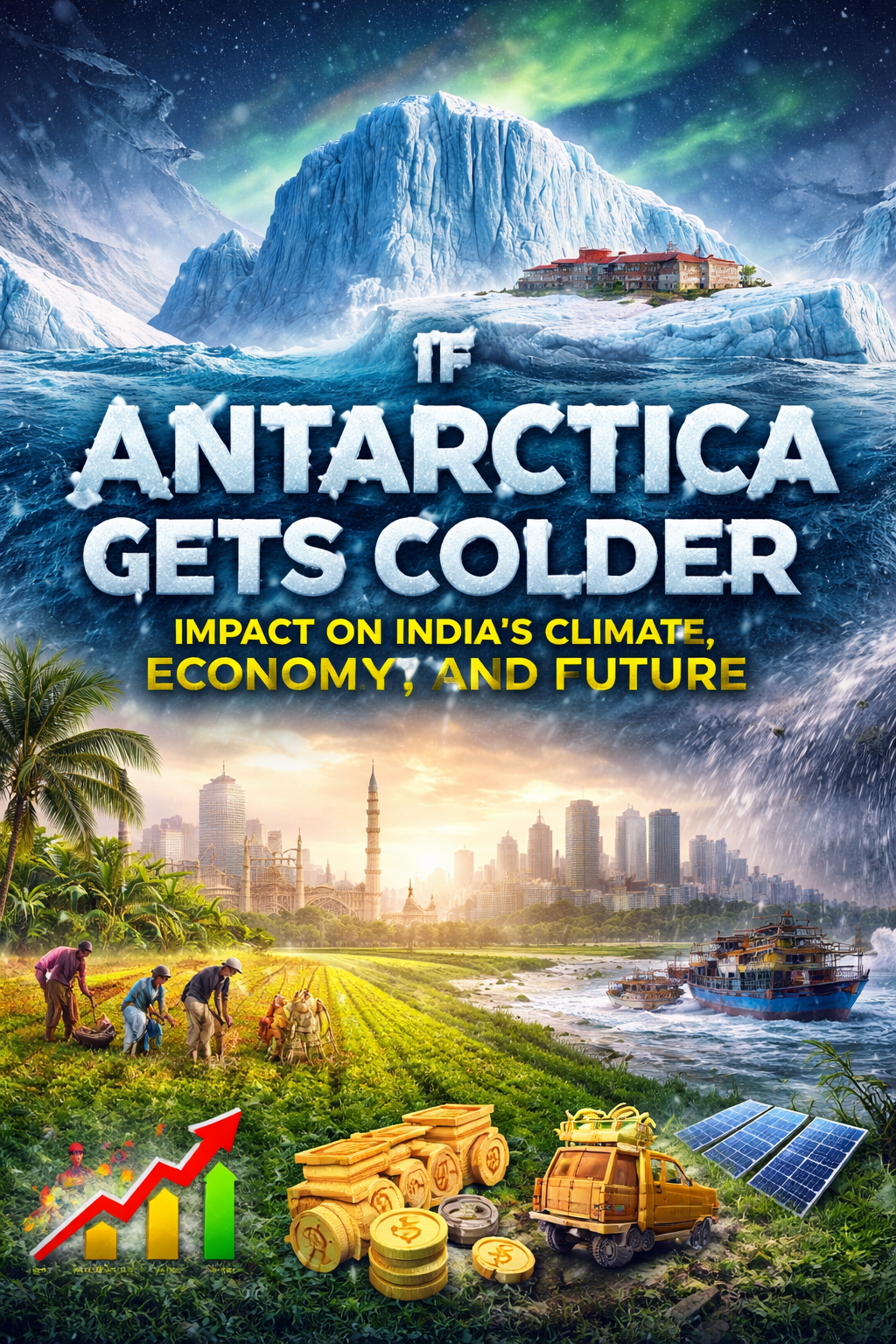
If Antarctica Gets Colder: A Deep Dive into What It Could Mean for India’s Climate, Economy, and Future
When we hear about
Antarctica, it often feels like a distant, frozen world—far removed from the
everyday realities of life in India. However, this icy continent plays a
surprisingly powerful role in shaping India’s climate, agriculture, economy,
and long-term sustainability.
Most conversations around
climate change focus on global warming. But what if the opposite happens in one
of the most critical regions on Earth? What if Antarctica becomes even colder?
This question opens the door
to an important discussion. Because while extreme cooling might sound less
dangerous than warming, it can disrupt global systems just as
significantly—especially for a climate-sensitive country like India.
Let’s explore in detail how a
colder Antarctica could influence India across multiple dimensions.
Antarctica:
The Hidden Driver of India’s Climate
Antarctica is not just a
frozen landmass; it is one of the central engines of Earth’s climate system. It
regulates temperature through its massive ice sheets, which reflect sunlight,
and through its surrounding oceans, which drive global circulation patterns.
India’s climate—particularly
the monsoon—is closely linked to global atmospheric and oceanic behavior. These
systems are interconnected, meaning that any major change in Antarctica can
ripple across continents and oceans, eventually influencing India.
The connection may not be
visible, but it is deeply embedded in how Earth functions.
The Monsoon
System: India’s Lifeline at Risk
The Indian monsoon is one of
the most important climatic phenomena in the world. It provides nearly 70% of
the country’s annual rainfall and supports agriculture, water resources, and
livelihoods for millions.
The monsoon depends on
temperature differences between land and ocean. When land heats up more than
the surrounding oceans, it creates pressure differences that drive moist winds
toward India.
If Antarctica becomes colder,
it can influence:
·
Global
wind circulation
·
Ocean
temperatures
·
Pressure
systems across hemispheres
Possible Impacts on Monsoon:
1.
Delayed Onset
Cooling effects may weaken the temperature gradient needed to initiate the
monsoon, causing delays.
2.
Irregular Rainfall
Some regions may receive excessive rainfall, while others face drought
conditions.
3.
Weaker Monsoon Winds
Reduced energy in the system could lead to lower rainfall overall.
For farmers in states like
Tamil Nadu, Karnataka, Maharashtra, and Punjab, such unpredictability can be
devastating.
Agriculture:
A Sector Highly Vulnerable
India’s agriculture sector
employs a significant portion of the population and is highly dependent on
climate stability.
A colder Antarctica could
indirectly lead to:
·
Lower
global temperatures
·
Changes
in seasonal cycles
·
Increased
frequency of cold spells
Effects on Crops:
·
Shortened Growing Seasons
Crops like rice and wheat require specific temperature ranges. Cooling can slow
growth and reduce yields.
·
Frost Damage
Unexpected cold waves can destroy crops, especially in northern India.
·
Shift in Crop Patterns
Farmers may need to change cropping cycles or switch to different crops, which
may not always be feasible.
Economic Impact:
Reduced agricultural output
can:
·
Increase
food prices
·
Affect
rural incomes
·
Create
supply chain disruptions
For a country with a large
agrarian population, this becomes a serious concern.
Indian
Ocean Changes and Their Consequences
The Indian Ocean plays a
crucial role in regulating India’s climate. It interacts with atmospheric
systems to influence rainfall, temperature, and storms.
Antarctica is a key driver of
global ocean circulation. If it becomes colder:
·
Formation
of dense cold-water increases
·
Ocean
currents may shift or intensify
·
Heat
distribution across oceans changes
Impacts on India:
·
Altered Sea Surface Temperatures
This can affect monsoon formation and intensity.
·
Changes in Marine Ecosystems
Nutrient flows may shift, affecting fish populations.
·
Cyclone Behavior
Warmer or cooler waters can influence the frequency and intensity of cyclones
in the Bay of Bengal and Arabian Sea.
Fisheries
and Coastal Livelihoods
India’s coastline supports
millions of people who depend on fishing and marine resources.
Changes in ocean temperature
and currents can:
·
Shift
fish migration patterns
·
Reduce
fish availability in traditional fishing zones
·
Affect
breeding cycles of marine species
Consequences:
·
Loss
of income for fishermen
·
Increased
competition for resources
·
Pressure
on coastal economies
States like Tamil Nadu,
Kerala, Andhra Pradesh, and West Bengal could face significant challenges.
Weather
Extremes and Atmospheric Changes
A colder Antarctica can
influence global wind patterns and jet streams. These changes can affect how
weather systems behave over India.
Possible Outcomes:
·
Stronger Cold Waves
Northern India may experience harsher winters.
·
Unpredictable Rainfall
Rain patterns may shift, affecting both urban and rural areas.
·
Increased Weather Variability
Sudden changes in temperature and precipitation could become more common.
Such variability makes it
harder to plan agriculture, infrastructure, and disaster management.
Food
Security and Inflation
Food security is closely tied
to climate stability. If agricultural production becomes inconsistent due to
climate changes:
·
Supply
may decrease
·
Demand
remains constant or increases
·
Prices
rise
Impact on Society:
·
Higher
cost of living
·
Increased
burden on low-income households
·
Greater
reliance on food imports in extreme cases
This can also lead to
economic stress and social challenges.
Climate
Imbalance and Long-Term Risks
One of the biggest concerns
with a colder Antarctica is the imbalance it introduces into the global climate
system.
India relies heavily on
predictable seasonal cycles. Any disruption can have cascading effects across
sectors.
Long-Term Risks:
·
Reduced
agricultural productivity
·
Increased
frequency of climate-related disasters
·
Strain
on water resources
Climate imbalance doesn’t
just affect one sector—it affects the entire economy and society.
The Cooling
Feedback Loop
A key scientific concern is
the possibility of a feedback loop caused by increased ice cover.
How It Works:
1.
Antarctica
becomes colder
2.
Ice
sheets expand
3.
More
sunlight is reflected back into space
4.
Global
temperatures decrease further
This cycle can continue,
reinforcing cooling over time.
For India, this could mean
prolonged changes in climate patterns that are difficult to reverse.
Urban Impact in India
Cities in India are also
vulnerable to climate changes.
Potential Effects:
·
Changes
in water availability
·
Increased
energy demand during colder periods
·
Strain
on infrastructure due to unpredictable weather
Urban planning depends on
climate predictability. Sudden shifts can create challenges in managing
resources effectively.
Scientific
and Strategic Importance for India
India is actively involved in
Antarctic research through stations like Maitri Station and Bharati Station.
These research efforts help
scientists understand:
·
Climate
patterns
·
Ice
behavior
·
Ocean
systems
Monitoring Antarctica is
essential for predicting future climate scenarios that may affect India.
Why This
Matters More Than Ever
Although extreme cooling in
Antarctica is not the primary concern today, understanding its potential
effects highlights how interconnected our planet is.
For India:
·
Climate
stability is crucial for agriculture
·
Ocean
health supports millions of livelihoods
·
Predictable
weather ensures economic balance
Even distant changes can have
local consequences.
Final
Thoughts
Antarctica may seem far away,
but its influence reaches deep into the heart of India’s climate system.
If temperatures there
decrease significantly, the impacts could include:
·
Disrupted
monsoons
·
Agricultural
challenges
·
Oceanic
changes
·
Economic
pressures
The key lesson is clear: Earth’s climate is
interconnected and delicate.
For a country like India,
maintaining this balance is essential for food security, economic stability,
and overall well-being.
Understanding the role of
Antarctica reminds us that no part of the planet exists in isolation. What
happens in the coldest region on Earth can shape the future of millions living
thousands of kilometers away.