India Publishes 5% of the World’s Research — But Accounts for 21% of Its Retractions. Here’s Why That Matters for Every Indian Researcher.
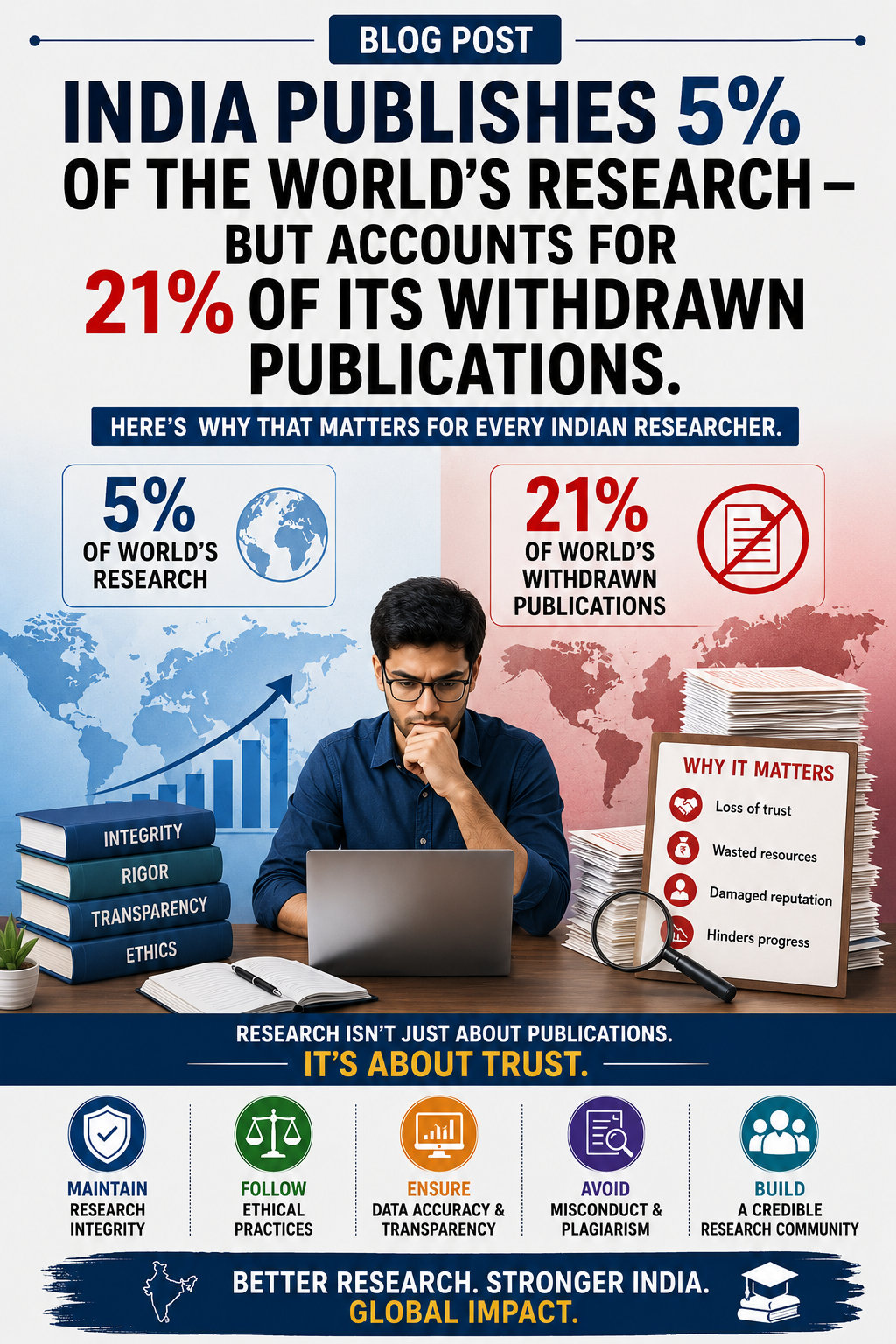
- There’s a number that should stop every Indian PhD student, faculty member, and research scholar in their tracks.
- India contributes roughly 5% of the world’s published research. Yet it accounts for approximately 21% of global retractions.
- That’s not a rounding error. That’s a structural crisis and it’s one that the global scientific community is now watching closely.
What Is a Retraction, and Why Does It Matter?
A retraction is
when a published research paper is officially withdrawn from the scientific
record. It’s one of the most serious events in a researcher’s career equivalent
to having your published work declared invalid.
Retractions
happen for several reasons:
•
Plagiarism (copying text, data,
or images without attribution)
•
Data fabrication or
manipulation
•
Duplicate publication of the
same work
•
Compromised or fake peer review
•
Honest errors significant
enough to invalidate the findings
When a paper is retracted, it doesn’t just
hurt the author. It damages the reputation of the institution, wastes the time
of researchers who cited that work, and erodes public trust in Indian science.
India’s Retraction Problem, by the Numbers
The data paints
a concerning picture:
•
India now ranks third globally
for life science retractions, behind only China and the United States countries
that publish many times more research than India does.
•
In 2025 alone, India accounted
for 20% of all global retractions, second only to China.
•
A comprehensive study analyzing
13,500+ retractions over 40 years confirmed India’s disproportionate position
in the global retraction landscape.
•
Among Indian retractions
studied, plagiarism was the single largest cause accounting for over 436 cases
in one analysis.
•
Over half of retracted Indian
papers were published in journals with an impact factor below 1.
The most alarming part? Many retracted papers
continued to receive citations even after withdrawal meaning flawed science
kept influencing other researchers’ work.
Why Is This Happening?
This isn’t a
question of Indian researchers being less capable. It’s a question of systems,
incentives, and infrastructure.
1. Publish-or-Perish Culture Without Guardrails
Indian
universities and funding bodies have increasingly tied promotions, PhD
completions, and institutional rankings to publication counts. The pressure to
publish fast and frequently pushes researchers toward shortcuts. When quantity
is rewarded over quality, quality suffers.
2. Rapid Output Growth Without Matching Infrastructure
India’s
research output has grown dramatically over the past decade. That growth is
genuinely impressive. But research infrastructure ethics training, peer review
culture, mentorship on academic writing hasn’t kept pace. The result is a large
cohort of researchers who are motivated to publish but underprepared for what
rigorous publishing requires.
3. Weak Penalties (Until Now)
For a long
time, the consequences of a retraction in India were limited. That is beginning
to change.
4. Paper Mills and Compromised Journals
Predatory
journals and paper mills services that sell authorship or fabricate peer
reviews have found fertile ground where publication pressure is high and
verification is low.
The Policy Shift: Things Are Changing
The good news
is that the problem is now being taken seriously at the highest levels.
India’s National
Institutional Ranking Framework (NIRF) has announced, for the first time,
that universities with high retraction numbers will face penalties in their
rankings. This is a major shift it means retraction is no longer just a
researcher’s problem. It’s an institutional problem.
INFLIBNET is
also developing AI-based tools to flag retracted papers in academic
repositories, and is building a machine-readable retraction registry linked to
author profiles. The message from the government is clear: the era of
consequence-free poor research is ending.
What This Means for You as a Researcher
If you’re a PhD
student or early-career researcher in India, this environment creates both
pressure and opportunity.
The
pressure: The bar for publication quality is
rising. Journals are scrutinising Indian submissions more carefully.
Institutions are being held accountable. The shortcuts that may have worked
five years ago are increasingly traceable and penalised.
The
opportunity: Researchers who build genuine
competence in research design, writing, reproducibility, and integrity will
stand out sharply in a landscape where many don’t. The gap between rigorous and
sloppy research is becoming more visible and more consequential.
The Gap That Rademics.ai Is Built to Close
Most Indian
researchers face a specific set of challenges that no single tool has addressed
end-to-end:
|
Challenge |
What’s Missing |
|
Originality and plagiarism risk |
Awareness of what constitutes plagiarism beyond
text including data and image reuse |
|
Methodology gaps |
Understanding what makes a study reproducible and statistically
valid |
|
Journal selection |
Knowing which journals are credible vs. predatory |
|
Manuscript quality |
Writing that meets international peer review
standards |
|
Citation accuracy |
Correct attribution practices throughout the
research lifecycle |
Rademics.ai is designed as an AI-powered academic research copilot built
specifically for researchers who want to produce work that survives peer
review, passes integrity checks, and contributes meaningfully to their field.
It’s not a
shortcut. It’s the infrastructure that should have been there all along.
Whether you’re
structuring your literature review, checking your methodology for gaps,
identifying the right target journal, or polishing your manuscript for
submission Rademics.ai is built to support every stage of that process, with
research integrity as a first principle, not an afterthought.
The Bigger Picture
India has the
talent, the ambition, and the institutional momentum to become a genuine global
leader in research. The retraction crisis is not evidence of a lack of
capability it’s evidence of a system that has prioritised metrics over
substance for too long.
The researchers
who will define Indian science in the next decade are the ones building their
careers on rigorous foundations today.
The tools to
do that are now available. The question is whether you choose to use them.